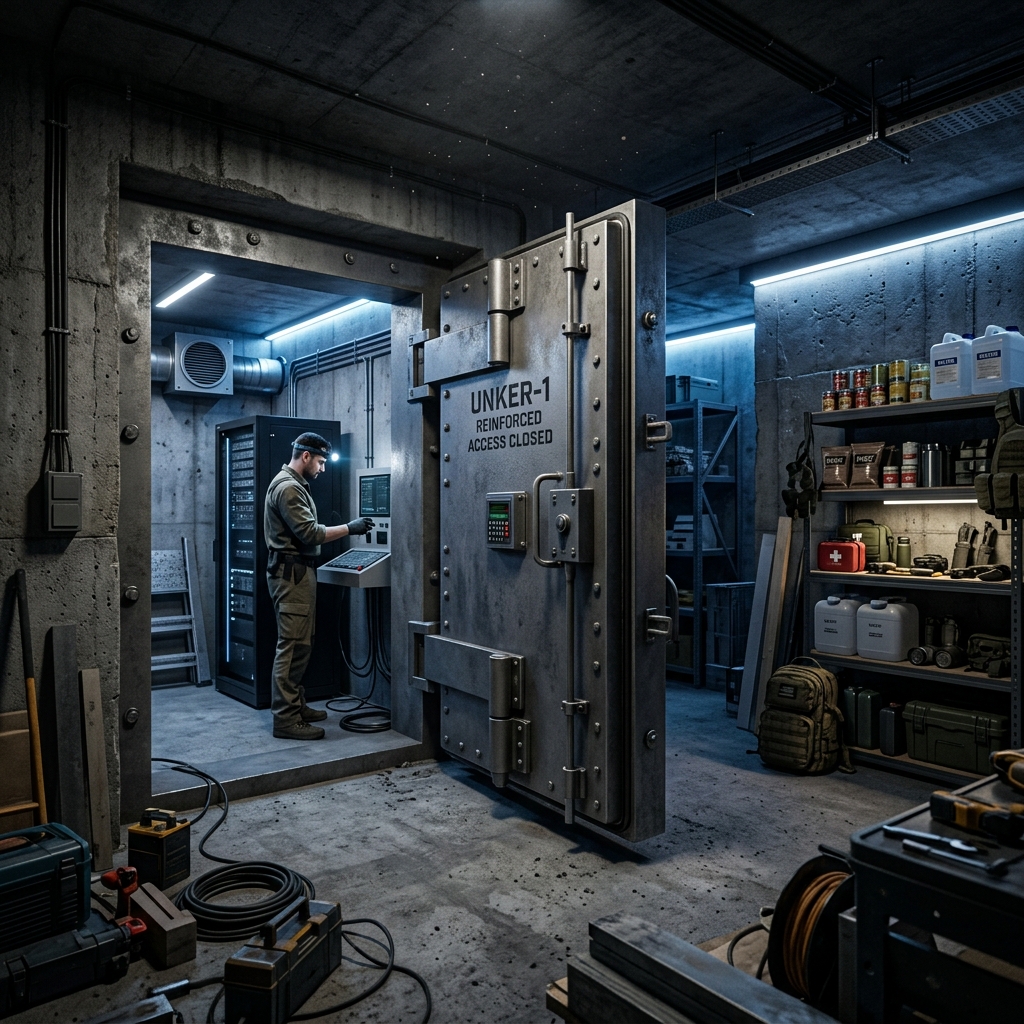
# How to Turn a Street Cellar into a Reliable Bunker: A Step-by-Step Guide
Having a street cellar on your property is the perfect starting point. Moreover, the best camouflage for a bunker is to hide its entrance under the guise of an ordinary cellar or shed, so as not to attract the attention of looters and neighbors in a crisis situation. However, ordinary earthen or brick walls will not save you from a shock wave or radiation. To turn a cellar into a real autonomous fortress, a serious modernization will be required.
Below is a step-by-step engineering plan for creating a bunker based on an already existing pit.
1. Waterproofing Check and Dimension Calculation
Before erecting walls, make sure there is no groundwater. If the cellar floods in the spring, it will turn into a pool, not a shelter.
The optimal depth of your shelter is **3 meters below ground level**. Each meter of soil reduces radiation by 10 times, and 3 meters will provide an attenuation coefficient of 1000 times.
The area is calculated according to the formula: 3 sq. m per person for a comfortable stay (or 1.5 sq. m for an emergency). For a family of four, the room should be about 3x4 meters, plus you must definitely allocate space for a vestibule and a bathroom.
2. Wall Reinforcement (Pressure Protection)
The earthen walls of the cellar will not withstand the pressure of the shock wave. You have three ways:
* **Monolithic reinforced concrete (standard):** Walls 30 cm thick made of M300 concrete with 12 mm reinforcement (pitch 200 mm).
* **Concrete rings:** A quick option is to lay concrete rings with a diameter of 2 meters horizontally.
* **Sea 20-foot container:** If you decide to lower a sea container into the cellar pit, **it absolutely cannot be simply buried**. The container is designed for a load from above, and the soil pressure on the sides will quickly flatten it into a "tin can". The container must be welded with a channel frame (120 mm with a pitch of 600 mm) and poured outside with 15 cm thick concrete.
3. Vestibule and Blast-Proof Door
The door to the bunker must withstand a pressure of at least 1 atmosphere. The most affordable option is an **8 mm thick steel sheet** on an angle frame, installed on three strong hinges, with a rubber seal around the perimeter and three gate valves.
Before entering the main room, a **vestibule (at least 1.5 x 1.5 m)** is strictly necessary. Under conditions of radioactive contamination, this is your decontamination zone. There should be a 20-liter water tank, soap, a change of clothes, and thick plastic bags to discard contaminated items here.
4. Ventilation and Air Purification
A person under stress consumes up to 40 liters of air per minute, and exceeding the carbon dioxide level to 3% leads to death.
* Install **two 100 mm diameter pipes** at different ends of the bunker. The supply pipe should lower to the bunker floor (outside it comes out 50 cm from the ground), and the exhaust pipe starts at the ceiling (outside exit - 1.5 meters above the ground). The pipes outside need to be camouflaged in the bushes.
* To supply air, use a duct fan (25 W) powered by a car battery.
* Be sure to install an FBU-100 civil defense filter or assemble it yourself from three layers: a fabric pre-filter, an H13 class HEPA filter, and a 5 cm thick carbon layer.
5. Bathroom and Emergency Exit (Mistakes that cost lives)
* **Bathroom:** Use a 20-liter chemical dry closet or a bucket with a tight lid, the waste in which is sprinkled with lime. **A separate 50 mm diameter exhaust pipe is required for the bathroom**, otherwise the air in the bunker will become unbreathable in a day due to ammonia.
* **Emergency Exit:** 90% of builders forget about this and create a trap for themselves. If the house or shed collapses on the main entrance of the cellar, you will be buried alive. Lay a 600 mm diameter pipe in the ground in advance at an angle of 30 degrees to the surface. The exit cover should be easy to open from the inside with a kick.
6. Electricity and Communications
* Install two 60 Ah car batteries. This will give 1440 Wh of energy - enough to run ventilation, LED lighting and charge phones for 48 hours. Batteries can be charged from a hidden 100 W solar panel through a controller.
* Ordinary electronics will burn out from the electromagnetic pulse of a nuclear explosion. To protect a spare phone, radio and controller, **make a "Faraday cage"**: a metal box, lined inside with cardboard, and wrapped outside with three layers of aluminum foil. Put a shortwave radio receiver (for example, TECSUN) inside, which runs on two AA batteries for up to 200 hours.
7. Food, Water and Psychology
* **Water:** Minimum 3 liters per person per day. For a family of 4, 168 liters will be required for 14 days of autonomy (these are nine 20-liter bottles).
* **Food:** The ideal choice is freeze-dried products (stored for up to 25 years) or military MREs (3200 calories per ration).
* **Psychology and medicine:** Confined space kills the psyche. Stock up on books, board games and pencils for children. Lay a warm white LED strip - it mimics daylight and reduces anxiety by 40%.
* Be sure to put potassium iodide (125 mg for adults) in the first aid kit to block radioactive iodine and buy a household dosimeter (for example, RDKS) to know exactly when the radiation level drops to safe (<0.5 μSv/h) and the door can be opened.